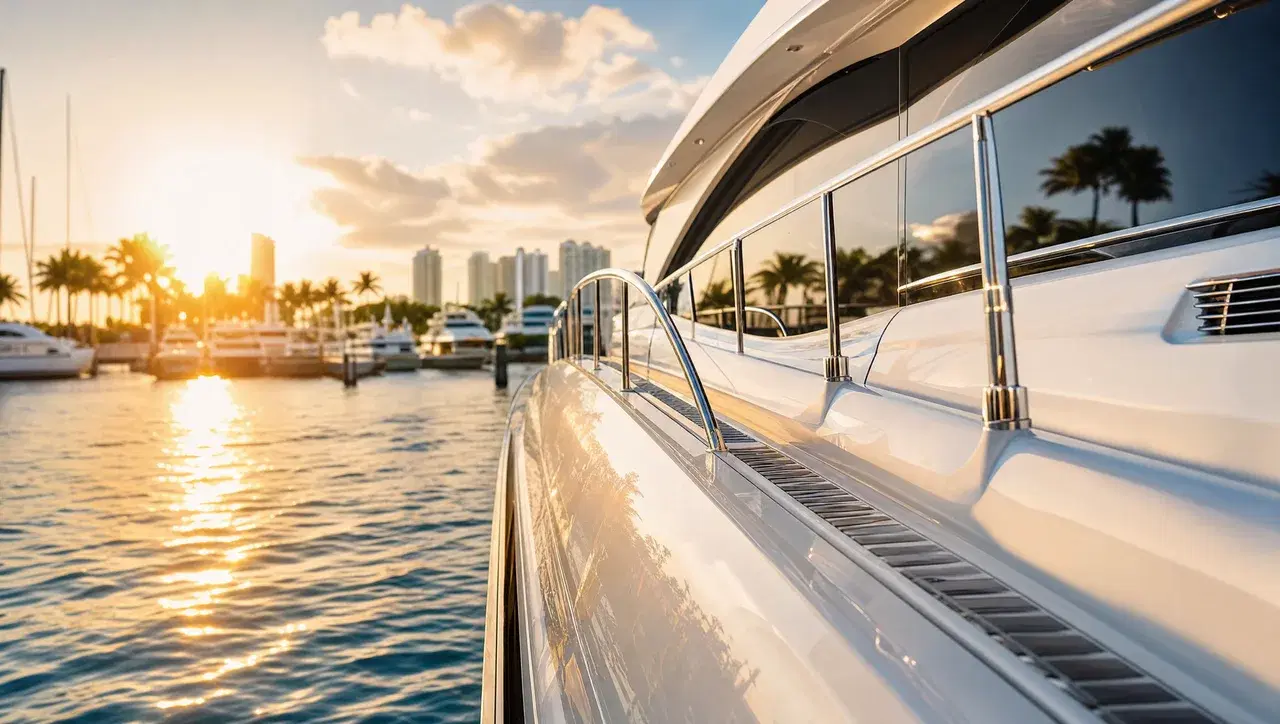
The Gold Coast is the roughly 90-mile stretch of Atlantic-facing coastline from Jupiter Inlet down to Key Biscayne, covering Palm Beach County, Broward County, and Miami-Dade County. Yacht detailing along that run means working in 36 ppt salt year-round, summer water temps near 88°F, and a UV index that punishes unprotected gelcoat fast. Every marina from Loggerhead to Dinner Key fights the same fight, just with different boats.
The Gold Coast runs about 90 saltwater-soaked miles from Jupiter Inlet to Key Biscayne. Every dock along it deals with the same combination: salinity near 36 ppt year-round, summer water temperatures pushing 88°F, and marine growth that can foul a hull bottom in under six weeks. The boats change, the marinas change, the conditions don't.
Why does South Florida's saltwater environment hit boats harder than most coasts?
Salinity along the Gold Coast holds near 36 parts per thousand year-round. There's almost no freshwater inflow to dilute it the way the Chesapeake or Long Island Sound get diluted. Gelcoat, teak, stainless steel, and aluminum cleats all pay for that concentration.
Heat compounds it. June through September, surface water temps run in the high 80s, and marine growth cycles that take three months in the Carolinas can run their course here in three weeks. According to NOAA's Tides and Currents data, Lake Worth and Virginia Key both routinely log August surface temps above 87°F.
UV is the other beating. South Florida's UV index averages higher than almost any place in the continental U.S., and unprotected gelcoat can chalk visibly in a single season. Hurricane season (June 1 through November 30) adds brackish storm surge and wind-driven salt spray that finds any hatch gasket past its prime.
What do boats docked in Palm Beach County need most, from Jupiter down to Boca?
Jupiter and Riviera Beach run heavy on sportfish. Loggerhead Club & Marina and Rybovich see 48' to 72' convertibles in and out daily, and the teak cockpit soles on those boats sit in saltwater and fish blood all season. Without regular Teak Care on roughly a 90-day cycle, the grain opens and grays, and restoration costs three times what maintenance would have.
Old Port Cove and North Palm Beach Marina dock more trawlers and mid-size motor yachts that stay in their slips year-round. Multi-year oxidation is the rule, not the exception, on those boats. By the time someone calls, the buffer is leaving orange-peel texture, and a single-stage polish won't cut it.
Sailfish Marina in Palm Beach Shores is a high-rotation charter stop. Boats that skip Exterior Detailing cycles show it within a season under that sun. Boca Raton Resort & Club is the other end of the spectrum: high-visibility docks where owners stay current on Ceramic Coating because the appearance bar is unforgiving.
How do detailing needs shift for vessels in Broward County between Deerfield and Hollywood?
Hillsboro Inlet traffic is brutal on topsides. Large center consoles and sportfish run offshore every day, and salt spray accumulates faster than weekly washes can keep up with. A Monthly Wash Program is the practical baseline for any boat on that inlet, not a luxury.
Bahia Mar and Pier 66 are superyacht row. Vessels above 100' routinely sit for multi-day Gelcoat Correction passes, usually with a Rupes BigFoot 21 on foam and a wool pad for the first cut. Coating any of those hulls without correcting first is money wasted, and any honest detailer will tell the owner that on the walkthrough.
Harbour Towne Marina in Dania Beach sits close to Port Everglades shipping traffic. Diesel exhaust fallout is a real contamination layer here, and topsides need a proper iron decontamination wash before anyone touches them with a polisher. The Intracoastal stretch through Broward is also slower-moving than the open Atlantic, and boats that rarely leave their slip accumulate more biological staining at the waterline than their offshore neighbors.
What makes Miami-Dade detailing different from the counties farther north?
Miami Beach Marina and Dinner Key in Coconut Grove dock a high concentration of European-flagged yachts and painted-hull charter boats. Awlgrip, Awlcraft 2000, and Imron behave nothing like gelcoat under a buffer. Pad choice and product selection change completely, and the wrong abrasive step on Awlgrip takes off more than oxidation.
Government Cut and Haulover Inlet stay rough most of the year. Vessels through those inlets take spray through hatches more often than boats in sheltered Broward basins, and interior mildew turns into a recurring problem instead of a seasonal one. Interior Detailing on those boats earns its place on a quarterly schedule.
Engine Room Detailing is the most overlooked service in Miami's charter-heavy fleet. Engines running hard daily in 90°F bilge temps accumulate grease and salt residue faster than anywhere else on the boat. By the time a captain notices, the soundproofing is stained and the bilge looks twenty years old.
Which Hull Renew, LLC services fit which vessel types along the Gold Coast?
The 40' to 60' center console crowd, running offshore most weekends, is best served by a Monthly Wash Program as the foundation, with Exterior Detailing every four to six months depending on how the gelcoat is holding. Skip the monthly washes and the four-month detail turns into a correction job.
A 100'+ tri-deck sitting at Rybovich or Bahia Mar year-round is a different program. Gelcoat Correction comes first, then Ceramic Coating, plus annual Teak Care on the cockpit and flybridge sole. Going straight to ceramic over oxidized gelcoat locks the haze in. You'll see it on every panel in raking light at sunset.
Sportfish with active engine rooms, a 64' Viking, a 72' Hatteras, need Engine Room Detailing on a schedule tied to their service intervals. Painted hulls running Interlux Micron CSC or Sea Hawk Cukote bottom paint need a detailer who reads the paint condition before recommending anything abrasive. Hull Renew, LLC is firefighter-owned and family-owned, and Hull Renew, LLC is fully insured for marine-services work, which matters more on a $4 million hull than it does on a center console.
How often should a Gold Coast yacht realistically be detailed to stay ahead of the environment?
Monthly wash minimum. Any vessel in any South Florida slip. Salt crust forms on chrome cleats in days at 36 ppt, not weeks, and it etches if you let it sit.
Full Exterior Detailing runs every three to six months on gelcoat hulls. Painted topcoats show contamination faster and usually need it every two to four months. Ceramic Coating extends the wash interval and protects against UV, but it is not maintenance-free, and any detailer who tells you otherwise is selling.
Teak is the one that punishes neglect hardest. Skip treatment for a full South Florida summer and the grain opens, the surface grays, and you're looking at a multi-day restoration with sanding instead of a half-day cleaning and oil. Cost goes up roughly three to four times when restoration replaces maintenance.
What should a yacht owner ask a detailer before hiring anyone along the Gold Coast?
Ask for proof of insurance specific to marine detailing work, not a general contractor policy. The two policies cover different risks, and a general policy won't help anyone when a buffer slips on a $200,000 paint job. Hull Renew, LLC is fully insured for marine-services work specifically.
Ask whether the detailer has actually worked on painted topcoats. The technique on Awlgrip is different from gelcoat in every meaningful way, and the wrong pad grit removes more than oxidation. Ask what products they use on teak and whether they do a test strip before committing to a full restoration. Reputable operations always test first.
Ask for references at a marina you can verify. A website gallery isn't a reference. A detailer who works Loggerhead, Bahia Mar, or Dinner Key regularly will have boat names and captain names to offer.
Frequently asked questions
How often does a boat docked in South Florida need to be washed?
Monthly is the minimum on any boat in any Gold Coast slip. Salt crust forms on chrome and stainless within days at 36 ppt salinity, and it etches if left alone. Boats running offshore weekly often benefit from a wash every two weeks rather than monthly, especially during the high-UV May through September window.
What is the difference between gelcoat correction and exterior detailing?
Exterior Detailing is a wash, decontamination, single-stage polish, and protection step. Gelcoat Correction is a multi-step abrasive process using compounds like 3M Perfect-It on a rotary polisher to remove oxidation and minor scratches at the gelcoat layer itself. Correction is what you do when polish alone won't bring the shine back, usually after two or three years of skipped detailing.
How fast does marine growth build up in South Florida summer water temps?
Fast. With surface water in the high 80s from June through September, a clean hull bottom can show slime within two weeks and start collecting barnacles inside six weeks. That's why most South Florida yards recommend bottom service every six to ten weeks during summer instead of the quarterly schedule that works fine up north.
Does ceramic coating hold up in South Florida's UV and saltwater conditions?
Yes, but with realistic expectations. A properly applied Ceramic Coating on prepped gelcoat will hold up well against UV chalking and water spotting for one to two years before it needs refresh. It is not maintenance-free, though. It still needs a monthly wash underneath it, and applying it over oxidized gelcoat locks the haze in permanently.
What service does a sportfish with a neglected teak cockpit actually need first?
Teak Care, and usually a full restoration rather than maintenance. If the grain is open and the surface has gone silver-gray, it needs cleaning, brightening, and oiling or sealing before any other exterior work. Doing exterior polishing first means runoff lands on the raw teak and contaminates it further.
Get a Yacht Detailing Quote
Find out what professional detailing would cost for your yacht with a free assessment from the Hull Renew team.
Get a Free Quote