A Monthly Wash Program is a scheduled maintenance service that strips salt crust, dock dust, bird droppings, and early biological growth off a yacht's topsides, glass, and hardware on a recurring visit cycle. In Palm Beach County, Broward County, and Miami-Dade County, where summer salt spray dries into abrasive crystals inside a day, that recurring rinse-and-wipe is what keeps gelcoat from chalking and chrome from pitting. It's preventive maintenance, not a car wash.
A Monthly Wash Program covers freshwater rinsing of the topsides, hull sides, and superstructure, plus glass cleaning, stainless and chrome wipedown, and a spray-on sealant to hold the shine. In South Florida heat, skipping it accelerates gelcoat oxidation and lets mildew set into upholstery. A good program also includes a walk-around inspection so small problems get flagged before they turn into fiberglass repair jobs.
What does a Monthly Wash Program actually cover?
The scope is specific. A standard Monthly Wash Program includes a freshwater rinse of topsides, hull sides above the boot stripe, and the superstructure; a soap wash with pH-neutral boat soap; chrome and stainless wipedown on cleats, rails, and exhaust ports; glass and portlight cleaning with microfiber; and a cockpit and helm-deck wash. On most South Florida programs, the visit closes with a spray sealant or quick-detail product on the topsides to extend the life of whatever wax or Ceramic Coating is underneath.
What's not included matters just as much. Bottom Cleaning, Teak Care, and Interior Detailing are separate service lines and aren't bundled into a wash visit. A wash crew won't oil teak or shampoo a salon. They will, however, run a visual inspection pass on every visit, flagging new oxidation, gelcoat chips, or canvas mildew before those things grow into expensive problems.
Why does South Florida's climate make monthly washing non-negotiable?
Salt spray at marinas like Old Port Cove or Bahia Mar dries into a crystalline crust on gelcoat within 24 hours in July. Rub that dry crust with a chamois the next day and you've just polished your boat with sandpaper. The UV index here is among the highest in the continental U.S., and salt-filmed gelcoat oxidizes visibly inside one season if it isn't washed and sealed.
Then there's the biology. Tropical humidity feeds mold spores on vinyl, mildew on canvas, and acid-etching from bird droppings (common at docks near Sailfish Marina and Loggerhead Club). Droppings will etch unprotected gelcoat in days, not weeks. Regular washing breaks the growth cycle before stains set, and that's the whole point.
What products and tools does a proper wash involve?
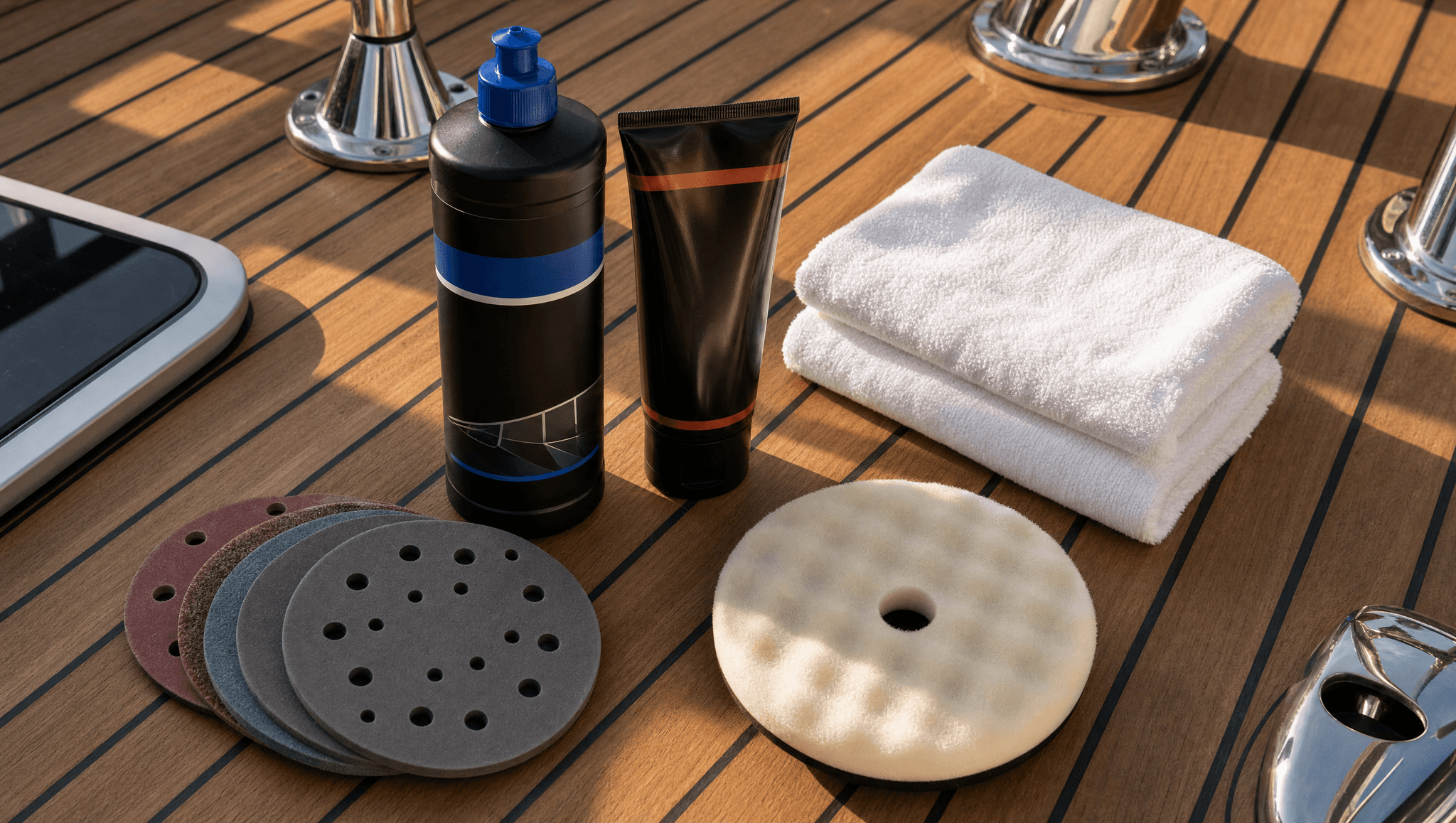
A pH-neutral boat soap, Star brite Premium or equivalent, gets used at the manufacturer's dilution. Dish soap is banned on a proper wash crew because it strips wax and accelerates oxidation, full stop. Soft-bristle brushes work the topsides; telescoping wash heads handle freeboard on vessels 60' and up; chamois or microfiber finishes glass so it doesn't streak in the Florida sun.
Metal hardware gets its own step. Stainless and chrome are wiped with a dedicated polish, Star brite Metal Polish or similar, to keep salt-pitting off cleats, rails, and exhaust ports. The final pass on topsides is a spray sealant or quick-detail product, which beads water for the next two to three weeks and makes the following visit easier.
How is a monthly schedule structured for boats that see regular use?
"Monthly" is the default cadence, but it's not the only one. An active 47' Sea Ray Sundancer running weekly out of Riviera Beach Marina builds up salt, fish blood, and bait residue faster than a slip-queen of the same length, and that owner often opts for bi-weekly visits. A 64' Viking at a covered slip in Lake Worth deals with more dock dust and bird traffic than open-air vessels, and the program adjusts.
Seasonal patterns matter too. Summer thunderstorms rinse some salt but leave water spots and biological deposits across the foredeck. Dry season brings airborne dust off the west. A written maintenance log, kept by the detailer and shared with the owner, notes visit dates, conditions observed, and products used. That log becomes the baseline for spotting deterioration trends a year out.
What should you expect a detailer to inspect during each wash visit?
A wash visit is also a five-point inspection. The detailer should be looking at gelcoat for new chalking, hairline crazing, or scratches that weren't there last month. They should be checking hardware for loose cleats, pitting chrome, and the white powder that means aluminum trim is corroding under the paint. Caught early, these are 15-minute fixes. Left alone for a season, they become fiberglass repair jobs.
Canvas, upholstery, and the waterline round out the pass. Mildew spotting on a flybridge cushion, a separating seam on an enclosure, UV fade on a bimini, biological buildup just above the antifouling paint line, those are the things a wash crew flags to the owner in writing. Waterline staining in particular is a tell: it often means the Bottom Cleaning interval needs to tighten up.
How does a Monthly Wash Program fit alongside other detailing services?
Monthly washing protects the work of a full Exterior Detailing. Without regular washes, a compound-and-polish job that ran $25 to $45 per linear foot of hull can dull out in three to four months in South Florida sun. With monthly washing and a spray sealant on every visit, that same correction holds for the better part of a year, sometimes longer.
Ceramic Coating changes the math. A hydrophobic surface sheds salt spray and biological debris far more easily, so each wash takes less time and less product. Teak Care and Interior Detailing typically run quarterly or semi-annually and get stacked onto wash visits to minimize disruption to the owner's schedule. A well-run monthly program also makes the annual Exterior Detailing cheaper, because less oxidation means less compounding.
What should you ask before signing up for a monthly wash contract?
Four questions, every time. First, is the company insured? Hull Renew, LLC is fully insured, and that matters because a detailer working on a 65' Viking at Harbour Towne Marina can cause real damage if they're not covered. Ask for a certificate of insurance, not a verbal assurance.
Second, what's included in writing? Get a scope checklist so there's no dispute later about whether stainless polishing or bilge vent wiping is part of the visit. Third, how do they handle missed visits when weather closes the marina or the boat is out cruising the Abacos? A reputable program has a clear make-up or credit policy. Fourth, do they keep a condition log with photos? Before-and-after photos on every visit protect both sides if a claim ever comes up.
For context on routine maintenance expectations, owner-focused resources like BoatUS and NMMA publish general care guidance that lines up with what a working detail crew sees on the docks. Hull Renew, LLC, a family-owned, firefighter-owned shop serving Palm Beach, Broward, and Miami-Dade, builds its Monthly Wash Program around the same baseline, with the climate adjustments above.
Frequently asked questions
How often should a yacht in South Florida be washed?
For most vessels in Palm Beach, Broward, or Miami-Dade, every four weeks is the baseline, with bi-weekly washes recommended for boats used more than once a week or docked under heavy bird traffic. Summer salt spray dries into crystalline crust within 24 hours, so longer intervals let abrasive deposits and acidic droppings sit on the gelcoat. Owners with Ceramic Coating can often stretch to monthly comfortably, because the hydrophobic surface sheds debris between visits.
What is the difference between a Monthly Wash Program and full Exterior Detailing?
A Monthly Wash Program is preventive: soap wash, hardware wipedown, glass cleaning, spray sealant, and a visual inspection on a recurring schedule. Exterior Detailing is corrective: compounding oxidized gelcoat, machine polishing, and applying a longer-lasting wax or Ceramic Coating. Most South Florida yards quote Exterior Detailing once or twice a year, with monthly washes in between to hold the result.
How long does a wash visit take on a 50-foot boat?
A two-person crew on a clean-running 50' express cruiser usually finishes in two to three hours, longer if the boat has been sitting two weeks with heavy salt and bird traffic. Time runs up on boats with extensive stainless, complex hardtops, or covered helm areas that need detailed work. A boat under a Ceramic Coating wash routine generally finishes on the faster end.
What happens to gelcoat if you skip regular washing in saltwater?
Salt crystallizes on the surface, traps UV-driven oxidation, and turns gelcoat chalky inside one Florida season. Bird droppings and tree sap etch into the resin in days, leaving rings that compounding can sometimes remove and sometimes can't. Skip washing for a full year on an unprotected hull and you're often looking at Gelcoat Correction rather than a simple wax to recover the shine.
Does a Monthly Wash Program include the bottom of the hull?
No. The hull bottom below the waterline is covered by Bottom Cleaning, an in-water dive service performed by trained divers, and it's billed separately. A Monthly Wash Program covers everything above the boot stripe: topsides, hull sides, superstructure, hardware, and glass. Owners typically schedule Bottom Cleaning every four to eight weeks depending on antifouling paint and growth rates.
Get a Yacht Detailing Quote
Find out what professional detailing would cost for your yacht with a free assessment from the Hull Renew team.
Get a Free Quote