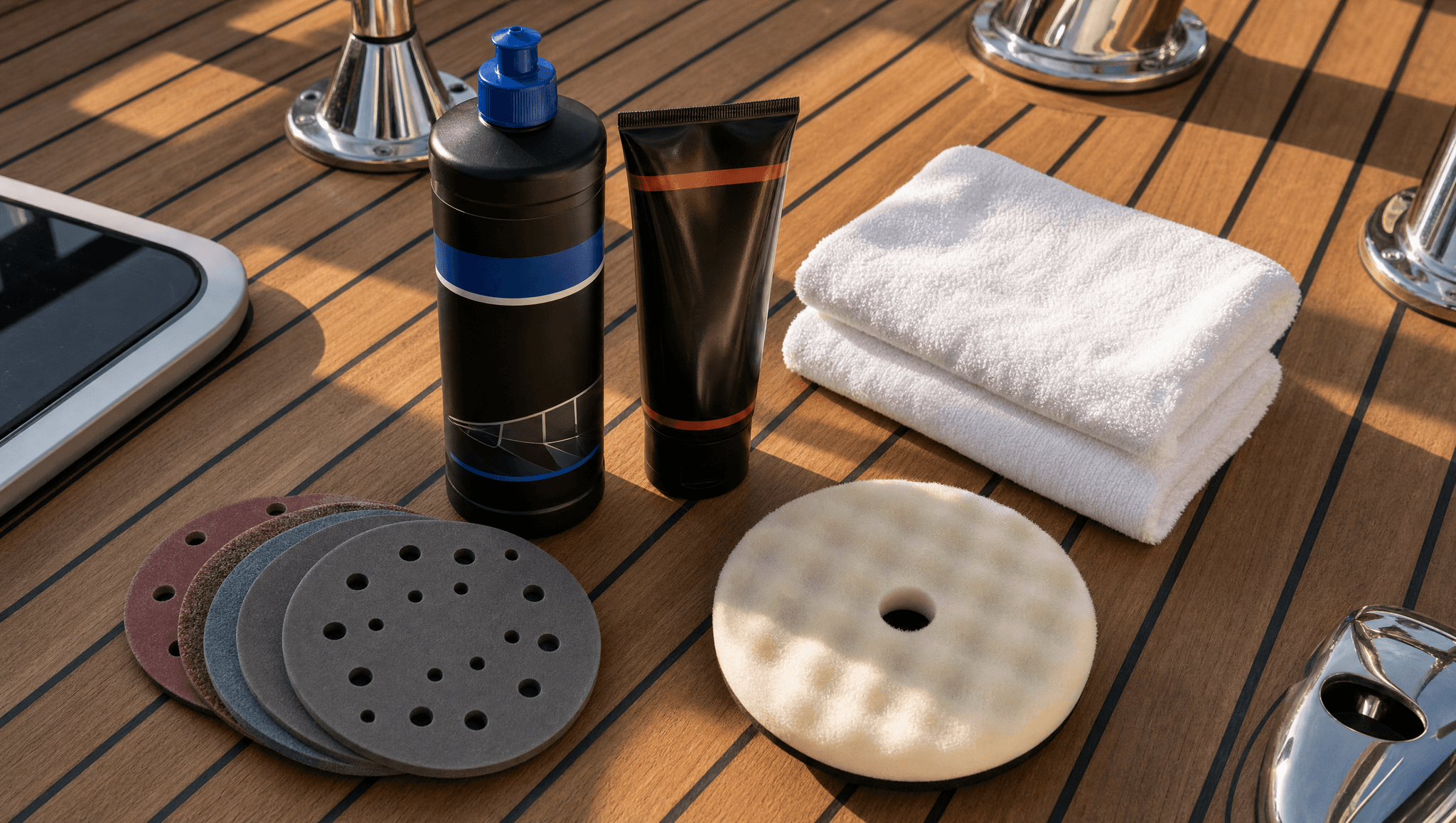
Walk onto any working yacht detailer's truck in Fort Lauderdale and you'll find the same three or four machines stacked next to a milk crate full of pads. Different brands, different motors, different price tags — but the tool list converges fast once you've buffed enough hulls under the South Florida sun. The products tell a similar story. A handful of compound and polish lines do roughly 90 percent of the actual correction work in this region, and the rest is marketing, packaging, or somebody's cousin trying to sell a private-label compound out of a garage in Stuart.
This is the gear list we'd hand a new hire on day one. Not the catalog of everything that exists — the short list of what survived a full season working on yachts between Palm Beach and Coconut Grove. Every item earned its spot the same way: by holding up against salt, UV, oxidized gelcoat, and the kind of customer who notices a single swirl mark in raking afternoon sun.
If you're a yacht owner trying to understand what your detailer should be running, or a crew member building out a kit before the next season, this is the reference. We've broken it into six categories, with the brand and model numbers we actually use, the trade-offs we've watched play out across hundreds of jobs, and the rough budget if you're starting from zero.
Rotary Polishers Pros Actually Use
When you ask a yacht detailer at Lauderdale Marine Center or Rybovich what machine cuts heavy oxidation off a 60-foot hull, the answer is almost always a rotary. They move metal — or in our case, gelcoat — faster than any dual-action tool. The trade-off is heat and the risk of swirl marks, so they belong in trained hands only.
The Makita 9227C is the workhorse rotary on most boats in our service area. It runs 0 to 3,000 RPM, has a 10-amp motor, and uses a 7-inch hook-and-loop backing plate. Pair it with a Lake Country wool cutting pad and a heavy compound and it pulls 1500-grit sanding marks out of oxidized gelcoat in one pass.
The Flex PE 14-2-150 is the European alternative. Slightly more refined RPM control, better balance, and a softer start that helps prevent compound sling. Costs roughly 100 dollars more than the Makita but pays back in operator fatigue on big jobs.
A few rules that matter on yachts specifically:
- Keep rotary speed under 1,500 RPM on vertical hull sides to control heat
- Never run a rotary dry — always have compound or polish on the pad
- Stay away from sharp edges, raised lettering, and rub rails — rotaries burn through fast on those spots
Random Orbital Machines for Finish Work
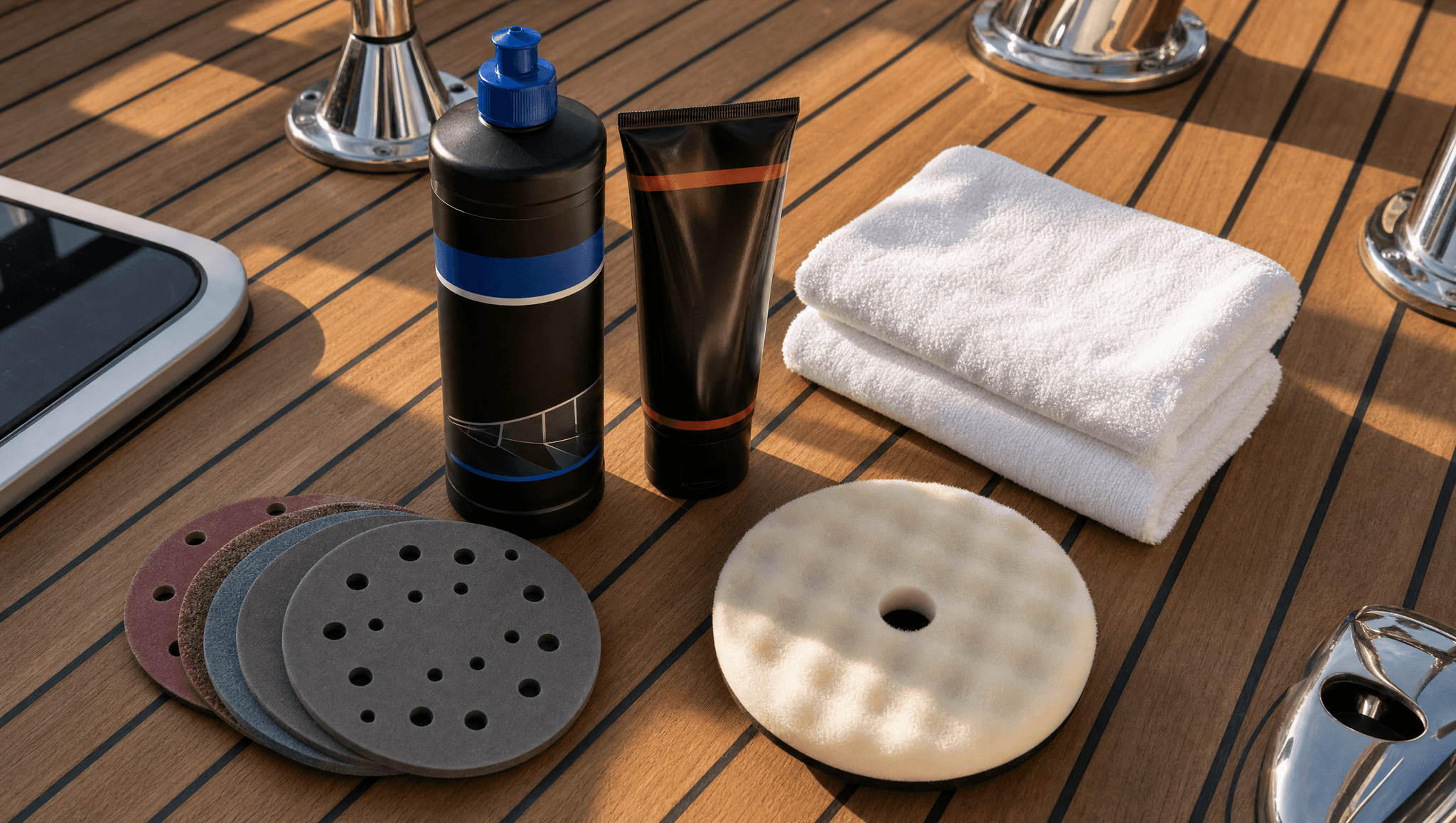
Once the heavy correction is done with a rotary, the finish pass is almost always a dual-action machine. They eliminate holograms, refine the gloss, and apply ceramic coatings without putting heat into the substrate.
The Rupes BigFoot LHR21 Mark III is the standard. A 21mm orbit, 4.2-amp motor, and forced-rotation behavior under load make it the most forgiving large-throw DA on a yacht hull. It cuts faster than any 8mm random orbital and finishes nearly as well.
For tighter spaces — rub rails, bow eyes, swim platforms — the Rupes Mini Mark III with its 75mm pad gets into corners the BigFoot cannot reach. Most full-service rigs carry both machines plus a 3-inch nano version for hardware bezels and cleats.
The other consideration is power. On a dock with no shore power, a battery-powered DA matters. The Rupes HLR75 Cordless and the Milwaukee M18 polisher both have enough runtime for a 50-foot exterior on a single charge. Bring a spare battery and a 60-foot extension cord either way.
Pads and Backing Plates
Pads are consumable, and yacht owners often miss this — a worn pad costs more in time and rework than a fresh one costs to replace. A professional crew rotates pads aggressively on every job.
For heavy cut on gelcoat, Lake Country wool pads in 7-inch and 6-inch sizes pull oxidation faster than any foam pad. The yellow Hybrid Wool blend is the most common. Plan on 3 to 5 pads per 50-foot hull job because they load up with oxidized gelcoat fast and need rotation.
For finish work and ceramic prep, Rupes Yellow (coarse), White (fine), and Blue (ultra-fine) foam pads cover the full polishing range. The Lake Country HDO orange and white pads are the closest American-made equivalent and cost about 20 percent less.
Backing plates matter more than most people think. Use a 6-inch flexible backing plate on contoured hull sections — anything stiffer transfers torque into the gelcoat and leaves uneven pressure. The Rupes 5-inch and 6-inch backing plates are pricey but balanced for the BigFoot's specific throw.
Wash pads after every job. Lake Country and Rupes both sell pad-washing buckets with grit guards that extend pad life significantly. A 20-dollar pad becomes a 200-dollar problem when residual compound contaminates a ceramic prep.
Compounds and Polishes
The compound and polish lineup is where amateur jobs go wrong. The wrong cut grade leaves either deeper haze or unfinished oxidation. Most pro yacht crews carry three product tiers minimum.
3M Perfect-It Marine Compound is the industry default in South Florida. It cuts hard, breaks down to a fine polish in the same pass, and works well with both wool and foam pads. The companion 3M Perfect-It Marine Finishing Material handles the swirl removal step after compounding.
Menzerna Heavy Cut Compound 1100 is the European alternative — slightly more aggressive on hardened gelcoat, lower dust, and a longer working time. The Menzerna SF 4500 finishing polish is what professional ceramic installers use to get a true zero-haze finish before coating.
For very oxidized hulls — boats that have sat unwashed for a year or longer — a wet-sanding step is sometimes required before any compound. Mirka Abralon discs in 1000, 2000, and 3000 grit on a soft interface pad cut through dead gelcoat without going through the layer. Most pros sand to 2000 or 3000 before compounding to save time.
A typical 3-step correction on heavily oxidized gelcoat looks like this:
- Wet-sand with Mirka Abralon 2000 grit on a soft interface pad
- Compound with 3M Perfect-It Marine Compound on a Lake Country wool pad, rotary at 1,200 to 1,500 RPM
- Finish-polish with Menzerna SF 4500 on a Rupes White pad, BigFoot at speed 4
Skip any step and the finish will not hold gloss past the first salt spray. The full multi-step process is exactly what our gelcoat correction service runs on hulls along the Intracoastal Waterway from Jupiter Inlet down to Miami Beach Marina.
Ceramic Coatings and Toppers
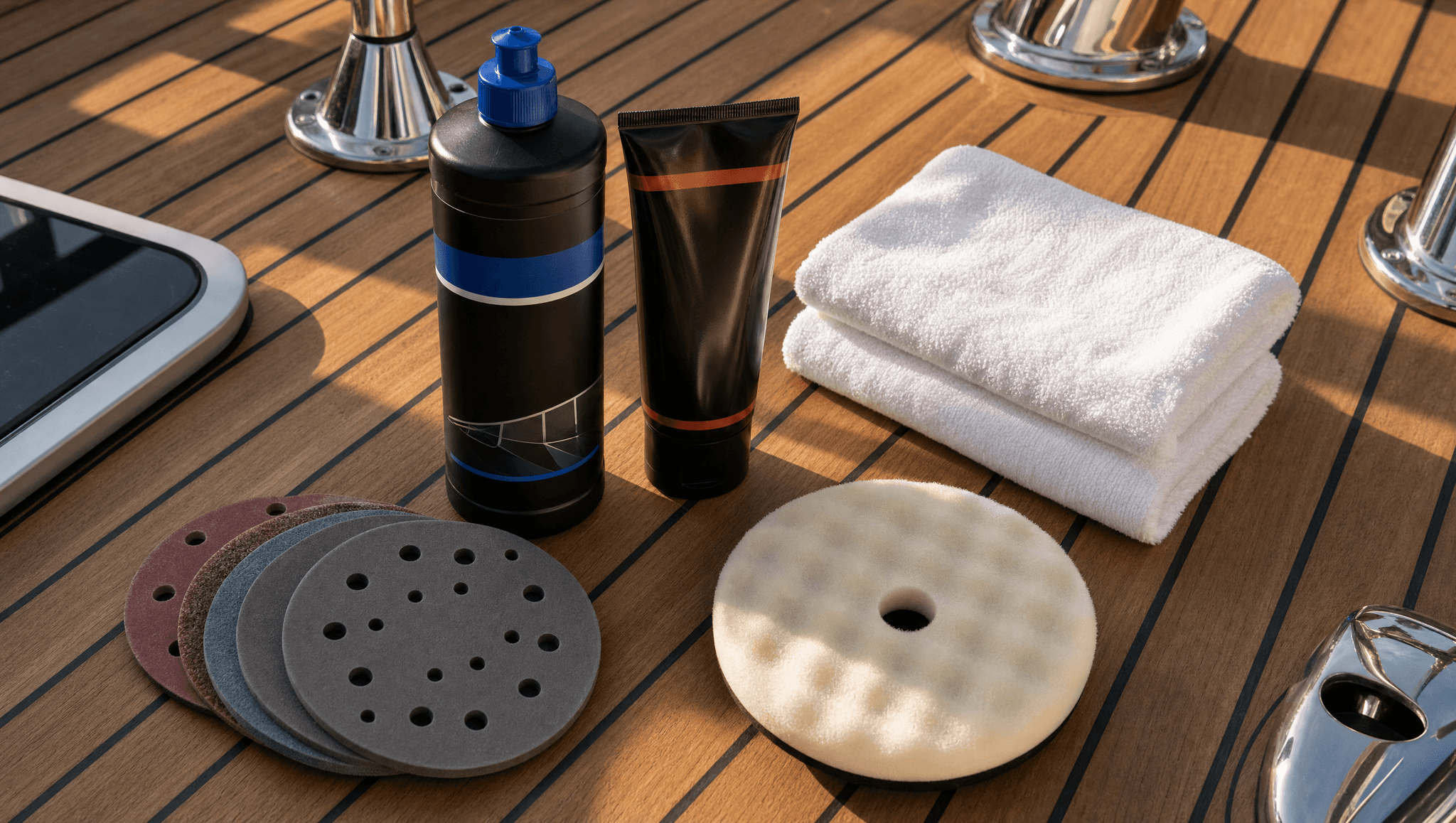
Once the surface is corrected and stripped of polish residue, ceramic coating goes on. Three product families dominate the yacht market.
Glidecoat Yacht Coating Professional is the most common ceramic on Hull Renew jobs. It is a 2-layer system, lasts 18 to 36 months in South Florida conditions, and was formulated specifically for gelcoat. The wipe-on, wipe-off application gives installers a generous working window before flash.
Gtechniq Marine is the European competitor — slightly harder cure, more chemical resistance, and a 30-day cure period before water contact. It costs more per kit but several large yacht programs in the Bahamas and Caribbean specify it for charter boats.
C.Quartz Marine by CarPro is a single-layer option that runs faster — useful when a yacht has a tight haul-out window or needs to splash inside 48 hours.
Toppers and maintenance sprays extend ceramic life significantly. After every wash, a quick wipe-down with Glidecoat Booster or CarPro Reload puts a sacrificial SiO2 layer over the base ceramic. That sacrificial layer takes the salt and UV hit instead of the base coating, which is what gets you to the 3-year mark instead of 18 months. For a deeper look at how ceramic chemistry holds up in South Florida conditions, see our complete ceramic coating guide.
Wash, Decon, and Maintenance Products
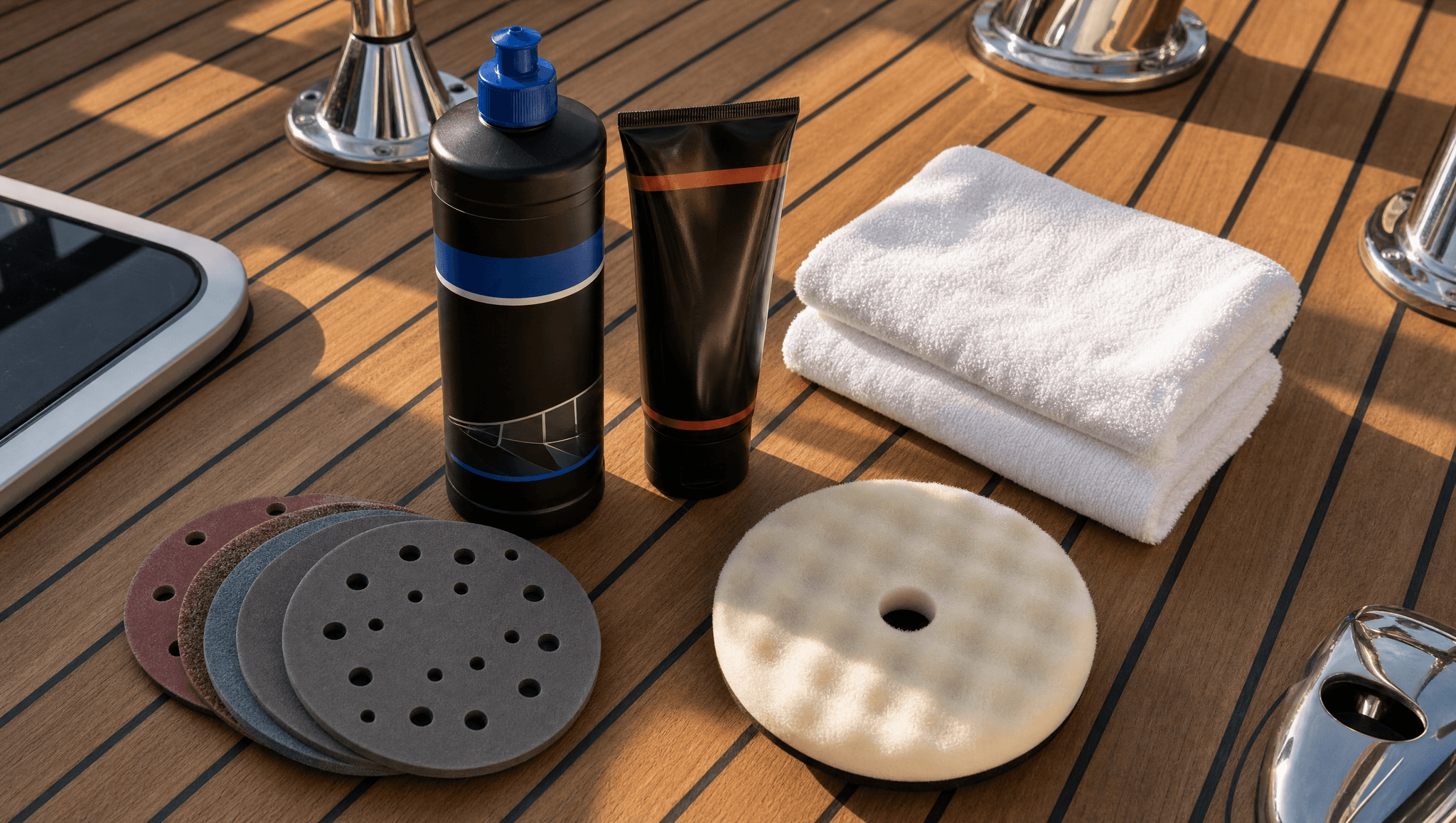
Between corrections and ceramic applications, the wash and decon routine determines how long the work lasts.
For weekly washes, a pH-neutral soap is non-negotiable on ceramic-coated boats. Chemical Guys Marine Soap and Star brite Sea Safe are the two most common on Hull Renew trucks. Both rinse clean without stripping the topper.
For monthly decon, an iron remover like CarPro IronX or Gyeon Iron pulls embedded ferrous contamination out of the gelcoat. South Florida marinas have constant brake dust from gantries and dockside foot traffic — without a quarterly iron decon, the hull develops orange-brown spots that compound cannot remove.
Clay bars get pulled out for the final decon before any ceramic or wax. Nanoskin Autoscrub mitts work faster than traditional clay and last 10 times longer. Mothers and Meguiar's both sell decent marine-specific clay bars under 15 dollars each.
For interior detailing, the kit shrinks considerably. 303 Marine Aerospace Protectant is the gold standard for vinyl, rubber, and plastic UV protection. Boat Bling Hot Sauce handles vinyl windows on enclosures, and Star brite Mildew Stain Remover handles the inevitable cabin mildew that South Florida humidity creates between charters.
If you are putting a kit together for the first time, start with the Makita 9227C, the Rupes BigFoot LHR21 Mark III, a 3-pad set of Lake Country wool and Rupes foam, 3M Perfect-It Marine Compound, Menzerna SF 4500, and Glidecoat Booster. That covers 80 percent of South Florida yacht work and runs roughly 1,200 to 1,500 dollars all-in.
Frequently asked questions
What is the best polisher for yacht detailing?
What compound do professional yacht detailers use?
How much does a professional yacht detailing tool kit cost?
Do I need both a rotary and a dual-action polisher for yacht work?
Get a Yacht Detailing Quote
Find out what professional detailing would cost for your yacht with a free assessment from the Hull Renew team.
Get a Free Quote