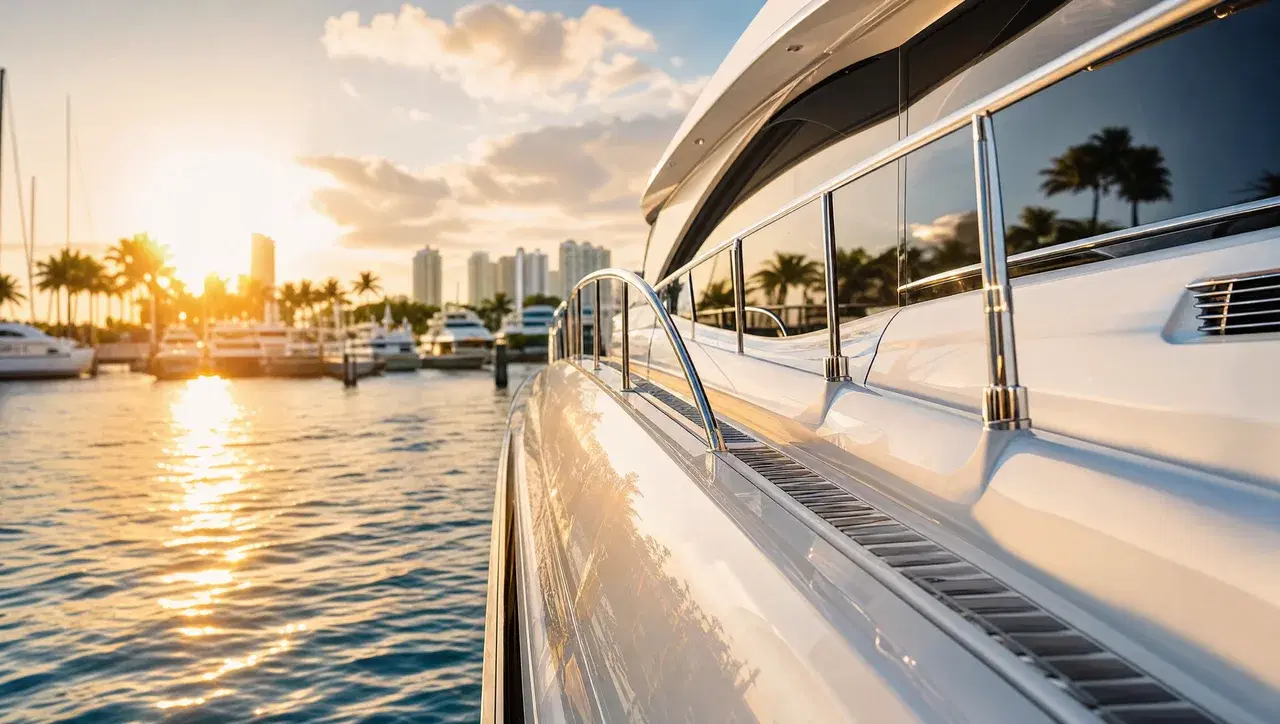
Superyacht detailing in Palm Beach is a scope-of-work problem before it's a labor problem. A 150-footer berthed at Rybovich carries more linear footage of painted topside, gelcoat, stainless, and teak than four 50-foot sportfish combined, and the Gold Coast climate eats unprotected finishes faster than almost anywhere else on the East Coast. This guide walks captains and crew through what professional detailing actually looks like on large-format vessels in Palm Beach County.
Palm Beach County runs some of the heaviest superyacht traffic on the East Coast, with vessels from 80 to 200-plus feet staging at Rybovich, Old Port Cove, and Sailfish Marina year-round. Saltwater concentration on the Gold Coast stays near 36 ppt, and summer heat accelerates oxidation and marine growth fast. This guide covers what a professional detailing program actually looks like for large-format vessels in this environment.
What makes superyacht detailing in Palm Beach different from standard yacht work?
Scale changes everything. A single compound pass on a 150-footer can run six or more hours with a two-person crew, and that's before you factor in the superstructure, the hardtop, or any of the trim. Linear footage is the number that drives the job.
The climate doesn't help. Gold Coast salinity sits near 36 ppt year-round, which accelerates oxidation on painted topsides (Awlgrip, Awlcraft 2000, Imron) and uncorrected gelcoat alike. A detailing schedule that works fine in the Chesapeake falls short in West Palm.
Then there's where these boats have been. Vessels arriving at Rybovich or Old Port Cove after an offshore passage come in with salt crust baked onto the hardtop, diesel soot streaking the transom, and waterline staining that won't yield to a regular wash-down. Add captain sign-off protocols, crew schedules, and dock-manager coordination, and the work demands a different operating rhythm than a weekend boat at a small marina.
What does a full exterior detailing scope look like on a 100-plus-foot vessel?
Exterior Detailing on a large vessel covers hull sides, topsides, superstructure, flybridge, hardtop, transom, and every piece of stainless and aluminum trim aboard. The scope should be itemized by zone before anyone quotes a number. A flat per-foot figure on a tri-deck almost always misses something.
On painted topsides, pad and machine selection follow paint condition. Fresh Awlgrip takes a lighter touch and pairs well with a Rupes BigFoot 21 DA. Weathered Awlcraft 2000 may need a rotary, often a FLEX XC 3401, to break down the oxidation before the polish step.
Chrome cleats, anchor hardware, and outboard stainless pit fast at Lake Worth Inlet. Those surfaces need individual attention, not a quick wipe. Plan two to three full days for Exterior Detailing on a 110-foot tri-deck, longer if the boat has been sitting through a wet summer.
When does a superyacht hull actually need Gelcoat Correction versus a standard polish?
Gelcoat Correction is warranted when the surface chalks white on a dry wipe, shows orange-peel texture under raking light, or has oxidation deep enough that polish alone leaves the color flat and hazy. A standard polish brightens. Correction removes material.
Vessels that winter in Palm Beach from November through April and then stage north often come back the following season with six-plus months of UV and salt loading on the topsides. That usually crosses the threshold from polish to correction. The buffer tells you within the first ten minutes whether the surface is going to wake up or not.
Correction on gelcoat starts with 3M Perfect-It Compound on a wool pad for the cutting phase, then 3M Perfect-It Polish on foam to refine the finish and clear buffer trails before any sealant goes on. Painted hulls are different. Paint thickness is finite, and an aggressive compound on thin Awlcraft 2000 can cut straight through to primer, which is a repaint, not a touch-up.
How does a Ceramic Coating program work on a superyacht in South Florida's climate?
Ceramic Coating on a 120-foot vessel is a multi-day installation, and most of those days are prep. Wash, decontamination, correction where the surface needs it, then panel-by-panel coating application. Skipping prep on a superyacht is how you lock defects in for the life of the coating.
South Florida humidity and direct sun make the application window narrow. Crews start at first light, because Palm Beach docks are routinely past 85 degrees by 9 AM in July, and most ceramic chemistries don't like flash-curing in direct heat. Boats Galaxy ceramic is one product used on large-format vessels in this market, but coat selection depends on the surface, gelcoat, painted topside, and brushed aluminum superstructure panels don't all take the same chemistry.
A cured ceramic coating on the topsides and superstructure meaningfully reduces the labor cost of the Monthly Wash Program over a full season. On a vessel where a single full wash-down runs three to four hours of crew time, that math adds up fast.
What should captains expect from a Monthly Wash Program on a large vessel at a Palm Beach marina?
A Monthly Wash Program at marinas like Sailfish Marina or Old Port Cove covers full freshwater rinse, soap and rinse, and protectant application on topsides and superstructure on a set cadence. During summer, that cadence should increase. Bi-weekly or weekly is realistic from June through September, when marine growth, dock-line residue, and salt load all climb together.
Summer water temps in the high 80s push organic staining hard between service visits. Algae blooms in the marina, bird activity on the hardtop, and stain transfer from old fenders all compound on a boat that sits. Catch it weekly and it wipes off. Let it ride a month and you're into a polish job.
Captains maintaining vessels for absentee owners get the most out of a documented program. Condition photos after each service catch gel chalking, paint hazing, and trim corrosion before they become correction work. Hull Renew, LLC runs Monthly Wash Program service across Palm Beach County and coordinates directly with crew or dock managers when owners are off-vessel.
What does Teak Care involve on a superyacht, and how often does it need to be done in this heat?
Teak Care on a large vessel covers cockpit soles, side decks, swim platforms, and any exterior teak furniture. Total teak square footage on a 100-foot motoryacht can run past 300 square feet once you add it all up. That's a real day of work, not a touch-up.
Untreated teak in direct Palm Beach sun grays out in weeks during summer. Mold and mildew get into the grain quickly once the natural oils break down, and IOSSO mildew-stain remover is often needed before any conditioner or sealant goes back on. You can smell when teak has gone too long. There's a slightly sour, damp note that doesn't come out with a soft-bristle brush and soap.
Most captains running vessels with serious teak schedule Teak Care every 90 days through the season. Vessels left unattended through hurricane season, June 1 through November 30, usually need a full clean-and-treat on return. Teak that's been allowed to gray and crack is harder and more expensive to restore than teak kept on a regular cycle, by a wide margin.
How do captains and crew vet a detailing operation before putting them on a superyacht?
Start with insurance. Verify the company is fully insured, and that Hull Renew, LLC carries coverage appropriate for high-value vessels. A certificate of insurance should be available on request before any crew grants dock access. If a vendor stalls on a COI, that's the answer.
Ask for references from vessels in the 80-to-150-foot range, not just center consoles and express cruisers. Technique and product knowledge scale differently on large superstructure work, and a strong reputation on 40-footers doesn't automatically transfer up. Look for crews who can talk about specific paint systems, specific compound and pad pairings, and the order they work a tri-deck.
Hull Renew, LLC is family-owned and firefighter-owned, which translates to a discipline-first approach to scheduling and job close-out. That matters when a captain is coordinating a detail around a charter window or a delivery. Check, too, that the operation knows the specific marina's access rules. Rybovich, Bahia Mar, and Pier 66 all credential vendors differently, and a crew that has never been on those docks will burn a half day getting through the gate. For broader guidance on marine-services vendor standards, both NMMA and ABYC publish useful reference material.
Frequently asked questions
How long does a full exterior detail take on a 100-foot superyacht?
Plan two to three full days with a two-person crew for a standard Exterior Detailing scope on a 100-foot vessel in average condition. Heavily oxidized topsides, neglected stainless, or a full superstructure with extensive trim can push that to four days. The single biggest variable is paint and gelcoat condition on arrival.
How often should a superyacht get detailed if it stays in Palm Beach year-round?
A documented Monthly Wash Program is the baseline, with frequency increasing to bi-weekly or weekly during the June-through-September summer window. Layer in a full Exterior Detailing pass once or twice a year, plus Teak Care every 90 days if the boat has significant exterior teak. Gelcoat Correction or repaint-level work is condition-driven, not calendar-driven.
What is the difference between Gelcoat Correction and a standard polish on painted topsides?
Painted topsides don't get gelcoat correction. The terminology matters. On Awlgrip, Awlcraft 2000, or Imron, the work is paint correction or paint polishing, and the abrasive sequence is much gentler because paint thickness is finite. Aggressive compounding meant for gelcoat will cut through paint to the primer, which is a repaint job, not a polish.
How do you maintain teak on a superyacht in South Florida heat?
Keep it on a 90-day cycle through the season. Soft-bristle brush with the grain, mild teak cleaner, freshwater rinse, dry, then condition or seal depending on the look the owner wants. Tackle mildew with a product like IOSSO before it sets into the grain. Avoid pressure washers on teak. They strip the soft summer grain and leave the deck looking ridged within a season.
What should a captain ask a detailer before giving dock access to a large vessel?
Ask for a current COI, references on similar-size vessels, a written scope by zone, and the specific products and pad sequence planned for the paint or gelcoat aboard. Confirm the crew knows the marina's vendor credentialing process. A detailer who can answer all of that without hedging is one worth scheduling.
Get a Yacht Detailing Quote
Find out what professional detailing would cost for your yacht with a free assessment from the Hull Renew team.
Get a Free Quote