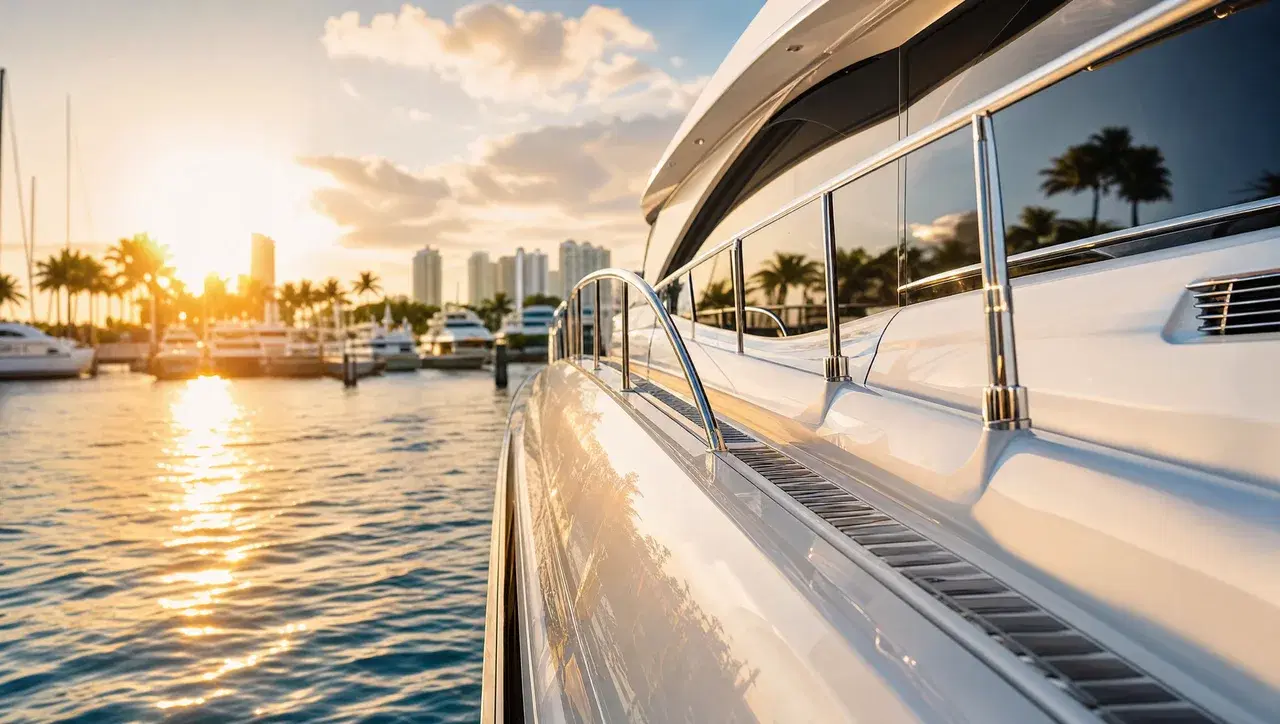
Yacht detailing in West Palm Beach means working a boat against one of the most aggressive saltwater environments in North America. Salinity in the Lake Worth Lagoon sits near 36 ppt year-round, summer water hits the high 80s, and the southeast trades push salt spray into every dock slip from Rybovich south to Riviera Beach. This guide walks through what detailing work actually makes sense marina by marina, and what to budget for.
West Palm Beach sits inside Palm Beach County's saltwater corridor where 36 ppt salinity and summer water temps in the high 80s accelerate oxidation and marine growth faster than most owners expect. The right detailing program depends on which marina the boat lives at and how often it runs. Below, we break down Rybovich, Old Port Cove, and Loggerhead, plus what to plan before hurricane season.
Why does West Palm Beach geography make detailing more demanding?
Lake Worth Lagoon is a semi-enclosed saltwater body. That matters because salt load on topsides accumulates faster here than at open-ocean anchorages where rain and breeze flush surfaces more frequently. Boats sitting in slips at Palm Harbor Marina or Rybovich Spencer often show visible chalking on dark hull stripes within a single summer if the gelcoat isn't sealed.
Summer water temperatures in the high 80s, sustained from June through September, drive barnacle and algae cycles into overdrive. Marine growth that takes four months to establish on a Carolina boat can build out in three weeks here. NOAA's tide-and-water-temperature data for the Lake Worth stations confirms what the divers see on every hull. See NOAA tides and currents for the local station readings.
Hurricane season runs June 1 through November 30, with peak activity in late August and early October. That adds a wash-and-inspect cadence most owners underestimate until they've lived through a season.
What detailing work suits boats at Rybovich Spencer Marina?
Rybovich hosts some of the largest vessels on the Palm Beach waterfront. The slips here hold everything from 80' sportfish to 200'+ superyachts on extended layovers. Long-term berthed boats accumulate heavy salt loads and diesel soot from working machinery, generators, and tender davits. Engine Room Detailing and Exterior Detailing on a recurring cycle aren't a luxury at this scale; they're how the boat stays presentable for charter brokers and surveyors.
Ceramic Coating is a strong fit for boats that sit between charters or deliveries. The hydrophobic surface sheds salt spray without a daily rinse, which matters when crew is off and the boat is dockside for three weeks. Teak Care is the other recurring need at this size class. Substantial cockpit, side-deck, and flybridge teak grays out within 90 days under Florida UV if it's left unprotected, and refinishing a fully neglected deck costs three to four times what regular maintenance would have run.
What should owners at Old Port Cove plan for each season?
Old Port Cove in North Palm Beach fills with seasonal boats that arrive in October and head north again in April or May. That creates a defined six-month maintenance window, and most owners don't use it well. A Monthly Wash Program through the winter prevents salt and dock dust from etching into gelcoat and staining the textured nonskid panels common on Hatteras, Viking, and Sea Ray decks.
Gelcoat Correction is the right pre-season investment for any boat arriving with visible oxidation. Address it on arrival, before the sun bakes the oxidized layer deeper into the laminate substrate. A 55' express cruiser that needs compound work in November can usually be brought back with a wool pad on a Makita 9227C and a couple of passes of 3M Perfect-It Compound followed by polish. Wait until March, and you may be looking at wet-sanding before the buffer touches it.
Interior Detailing on arrival is worth doing too. Boats closed up during a hot, wet summer grow mildew spores fast inside enclosed cabins, and you don't want to find that out the first time guests come aboard.
How does Loggerhead Club and Marina compare as a detailing environment?
Loggerhead Club & Marina in Riviera Beach attracts a different fleet. The slips hold center consoles and mid-size sportfish in the 40' to 65' range, owners who run Lake Worth Inlet hard and often. These boats collect salt on every surface above the waterline after every trip, and prop wash kicks biological material up onto the transom and lower hull sides. Wax-based finishes won't last more than eight weeks in this use pattern.
Exterior Detailing on a monthly or six-week cadence is the practical minimum for actively fished boats. Bottom Cleaning frequency climbs hard in summer. Owners who run their boats weekly may still see growth accumulation on the running surface within three to four weeks during peak temperature months. If you're seeing a noticeable drop in cruise speed at the same RPM, the bottom is past due.
What detailing services matter most in the months before hurricane season?
May and early June are the last clean window before late-summer storms. That makes it the right time to assess gelcoat integrity and seal any bare or thin areas before sustained UV and heavy rain arrive. Ceramic Coating applied before June gives the hull a hydrophobic barrier that sheds standing water from storm rainfall and simplifies post-storm washdowns when crews are stretched.
Teak Care and hardware polishing should be completed before the season, not after. Storm surge and driving rain force salt into every crevice and behind every fitting, and corrosion that starts in August takes months to chase out. Starting a fresh Monthly Wash Program in June also keeps the hull documented in good condition for any insurance inspection or pre-sale survey after the season ends.
How do you match detailing service choices to a vessel's actual use pattern?
A 47' center console running three days a week needs a different program than a 112' motoryacht that moves twice a year. Service frequency should track hours on the water, not just the calendar. Boats that sit in slips full-time accumulate biological staining on the waterline and lower hull sides from dock runoff, and that's a separate problem from topsides oxidation, addressed with different chemistry and different pads.
Gelcoat Correction is a one-time restoration, not a recurring service. The right follow-on is Ceramic Coating, or at minimum an Exterior Detailing with sealant to protect what the compound just exposed. Skip that step and the corrected hull will oxidize again inside a year. Interior Detailing frequency depends on whether the boat is charter-used, liveaboard, or a weekend vessel. A liveaboard at Rybovich needs cabin service every six to eight weeks; a weekend boat may only need it quarterly.
What does professional detailing at West Palm Beach marinas actually cost?
Exterior Detailing on a 50' express cruiser typically runs $600 to $1,000 depending on condition. Heavily oxidized hulls that need compound work before polish sit at the top of that range or above. Ceramic Coating scales with vessel size and the number of surfaces coated. A full exterior coating on a 65' sportfish commonly falls in the $3,500 to $6,500 range in the Palm Beach County market.
Monthly Wash Program pricing is tiered by length. Most South Florida yards quote $150 to $350 per wash visit for vessels in the 40' to 70' range, with discounts negotiated on multi-month agreements. Teak Care typically runs $12 to $22 per square foot for a full clean, brightener, and oil or sealer application. The square footage on an 80' yacht adds up faster than most owners anticipate, especially once you count side decks, cockpit, swim platform, and flybridge.
Hull Renew, LLC is a family-owned, firefighter-owned detailer working Palm Beach County, Broward County, and Miami-Dade County. Hull Renew, LLC is fully insured and holds itself to superyacht-grade standards on every vessel, regardless of size.
Frequently asked questions
How often should a boat at a West Palm Beach marina get washed?
For most boats in slips year-round, every two weeks is the practical floor and weekly is better. Salt load builds fast in Lake Worth Lagoon, and dock dust mixed with salt etches into gelcoat if it sits more than a few weeks. Boats that run frequently or sit unprotected from southeast spray should be on a Monthly Wash Program at minimum.
What is the best time of year to schedule gelcoat correction in Palm Beach County?
October through March is the right window. Cooler temperatures and lower humidity make compound and polish flow predictably under the pad, and the corrected surface gets weeks of mild conditions to cure before summer UV ramps up. Avoid scheduling correction in July or August unless the boat is under cover.
How quickly does marine growth build up on a hull in West Palm Beach waters?
In summer, with water temps in the high 80s, soft fouling can establish in two to three weeks on an unprotected bottom. Hard growth like barnacles typically follows within four to six weeks. Winter months are slower, but growth never fully stops in this climate, which is why most local boats run on a recurring Bottom Cleaning schedule.
Does ceramic coating hold up through South Florida hurricane season?
Quality marine Ceramic Coating products perform well through storm conditions, including driving rain and salt spray, when applied correctly to a prepared surface. They don't stop physical damage from debris, of course. After a storm, inspect the coated surfaces and wash off any contamination promptly; a coating sheds water but won't self-clean indefinitely.
What detailing services are most important for a sportfish that runs Lake Worth Inlet regularly?
Exterior Detailing every four to six weeks, Bottom Cleaning roughly monthly in summer, and Engine Room Detailing on a quarterly cycle cover the practical baseline. Add Teak Care twice a year if the boat has substantial teak, and consider Ceramic Coating after the next gelcoat correction to extend the time between full details.
Get a Yacht Detailing Quote
Find out what professional detailing would cost for your yacht with a free assessment from the Hull Renew team.
Get a Free Quote